



Preparing for the Joint Entrance Examination – Main and Joint Entrance Examination – Advanced is a long journey that requires months of dedicated study. However, no matter how well you prepare, your performance in the exam largely depends on how effectively you revise.
Many students spend months learning new concepts but fail to revise them regularly. As a result, they forget important formulas, concepts, and problem-solving techniques before the examination. On the other hand, students who revise systematically retain information better, solve questions more confidently, and perform well under exam pressure.
In this blog, we will discuss the best revision strategies for JEE and how you can make your revision more effective.
Why is Revision So Important for JEE?

JEE is not an exam that tests only your knowledge—it also tests how quickly you can recall concepts and apply them to solve complex problems.
Without proper revision:
- Important formulas are forgotten.
- Concepts become unclear over time.
- Problem-solving speed decreases.
- Confidence during exams reduces.
Regular revision helps students:
- Strengthen conceptual understanding.
- Improve memory retention.
- Increase speed and accuracy.
- Build confidence for the actual examination.
Revision is not a last-minute activity—it should be a regular part of your preparation from the beginning.
Revise Regularly Instead of Waiting for the End
One of the biggest mistakes students make is postponing revision until the syllabus is complete.
This often leads to information overload and unnecessary stress.
A much better strategy is to revise continuously.
For example:
- Revise today’s class notes on the same day.
- Revise the week’s topics every weekend.
- Revise older chapters every month.
This cycle ensures that concepts remain fresh throughout your preparation.
Prepare Short Revision Notes
Writing detailed notes during revision wastes valuable time.
Instead, prepare concise revision notes containing:
- Important formulas
- Key concepts
- Short tricks (where appropriate)
- Frequently made mistakes
- Important exceptions
These notes become extremely useful during the final weeks before JEE.
Students should update these notes regularly whenever they learn something new.
Focus on Conceptual Revision
Revision does not mean reading textbooks repeatedly.
Instead of simply reading theory, ask yourself:
- Why does this formula work?
- Can I derive it?
- Where can this concept be applied?
- Which chapters are connected to this topic?
Understanding concepts deeply makes them easier to remember and apply in unfamiliar situations.
Solve Questions During Revision
JEE is a problem-solving examination.
Therefore, revision should always include question practice.
While revising a chapter:
- Solve conceptual questions.
- Attempt numerical problems.
- Practice mixed-topic questions.
- Solve previous years’ JEE questions.
Question practice reinforces concepts much better than passive reading.
Revise Mistakes More Than Correct Answers

Many students repeatedly solve questions they already know.
Instead, give greater attention to:
- Incorrect questions from mock tests
- Frequently repeated mistakes
- Weak chapters
- Difficult concepts
Maintaining an error notebook can be extremely helpful.
Whenever you make a mistake, write down:
- The concept involved
- The reason for the mistake
- The correct approach
Revisiting this notebook regularly prevents repeating the same errors.
Use Mock Tests as a Revision Tool
Mock tests are not only for evaluation—they are also one of the best revision methods.
Every mock test exposes:
- Weak concepts
- Time management issues
- Calculation mistakes
- Chapters needing further revision
After every test:
- Analyze every incorrect question.
- Revise the related concepts.
- Solve similar questions again.
The analysis is often more valuable than the test itself.
Revise Physics, Chemistry, and Mathematics Differently
Each subject requires a slightly different revision approach.
Physics
Focus on:
- Conceptual understanding
- Formula derivations
- Numerical practice
- Application-based questions
Simply memorizing formulas is not enough.
Chemistry
For Physical Chemistry:
- Revise formulas.
- Solve numericals regularly.
For Organic Chemistry:
- Revise reaction mechanisms.
- Practice reaction-based questions.
- Understand concepts rather than memorizing blindly.
For Inorganic Chemistry:
- Revise NCERT thoroughly.
- Memorize important trends, exceptions, and reactions.
- Read frequently because factual information fades quickly.
Mathematics
Revision in Mathematics should focus on:
- Formula recall
- Problem-solving techniques
- Multiple approaches to questions
- Speed and accuracy
Daily practice is essential because mathematical skills improve through repetition.
Revise Using Previous Years’ Questions
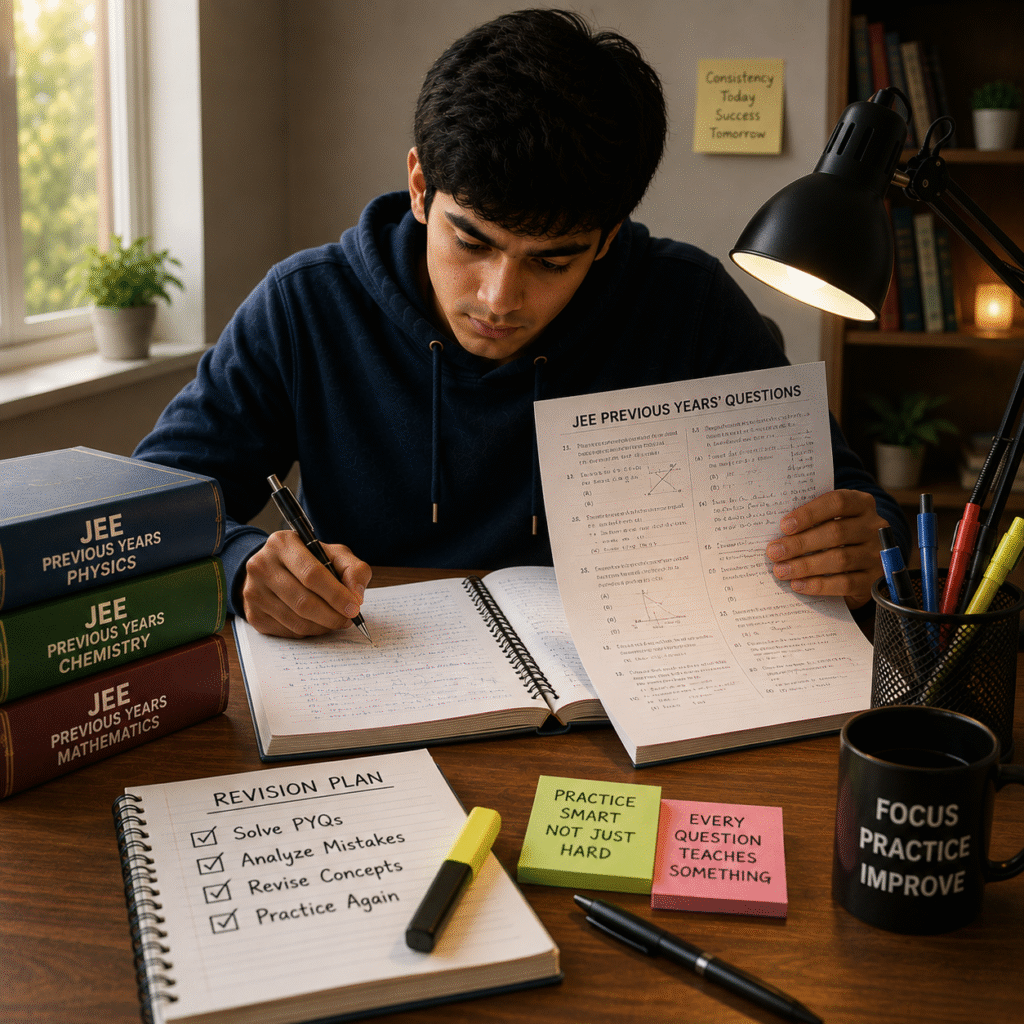
Previous years’ JEE questions are one of the best revision resources.
They help students:
- Understand the exam pattern.
- Identify important topics.
- Improve application skills.
- Build confidence.
Students should solve previous years’ questions chapter-wise during preparation and full papers during the final revision phase.
Follow the 3-Level Revision Strategy
An effective revision plan can be divided into three stages.
Level 1: Daily Revision
Spend 30–60 minutes revising topics studied that day.This prevents forgetting newly learned concepts.
Level 2: Weekly Revision
Every week:
- Revise completed chapters.
- Solve mixed questions.
- Review short notes.
Weekly revision strengthens long-term retention.
Level 3: Monthly Revision
At the end of every month:
- Revise all completed topics.
- Attempt full-length tests.
- Analyze weak areas.
- Update revision notes.
This keeps the entire syllabus fresh throughout the year.
Avoid Learning New Topics During Final Revision
As the examination approaches, many students panic and start studying completely new chapters.
This often creates confusion and reduces confidence.
The final weeks should focus mainly on:
- Revising known concepts
- Solving mock tests
- Reviewing mistakes
- Strengthening weak chapters
A strong command over already prepared topics is more valuable than superficial knowledge of new ones.
Maintain a Formula Book
Every JEE aspirant should maintain a separate formula notebook containing:
- Physics formulas
- Mathematics formulas
- Important Chemistry equations
- Frequently forgotten concepts
Reading this notebook daily during the last month greatly improves recall speed.
Stay Healthy During Revision
Revision is mentally demanding.
Students should:
- Sleep for 7–8 hours.
- Eat healthy meals.
- Take short breaks.
- Stay physically active.
- Avoid excessive screen time.
A healthy mind remembers concepts much more effectively.
Importance of the Right Academic Guidance

Revision becomes much more effective when students receive proper guidance and regular feedback.
Students searching for the best coaching for Science and Maths in Dehradun should choose institutes that provide:
- Concept-based teaching
- Small batch sizes
- Personalized mentoring
- Chapter-wise revision sessions
- Regular mock tests
- Detailed performance analysis
Institutes like Igniters for Tomorrow help students revise systematically through structured test series, continuous doubt-solving sessions, and individualized feedback. By focusing on conceptual understanding rather than rote learning, students are better prepared for both JEE Main and JEE Advanced.
Conclusion
Revision is the bridge between preparation and performance. Even the best preparation can become ineffective without systematic revision. Students who revise regularly, solve quality questions, analyze their mistakes, and strengthen weak areas consistently perform better than those who simply keep studying new topics.
Remember, JEE is not about how much you have studied—it is about how much you can recall and apply accurately under exam conditions. By following a disciplined revision strategy, maintaining concise notes, practicing previous years’ questions, and taking regular mock tests, you can maximize your performance and move one step closer to your dream of studying at an IIT, NIT, or another top engineering college.
Stay consistent, trust your preparation, and let every revision session bring you closer to success.
Leave a Reply