



Every year, lakhs of students preparing for the Joint Entrance Examination – Main ask one common question:
“Is NCERT enough for JEE Main?”
The simple answer is:
NCERT is essential, but for most students, NCERT alone is not enough to secure a very high percentile in JEE Main.
NCERT forms the foundation of JEE preparation. It helps students build strong concepts, especially in Chemistry, but JEE Main also tests conceptual application, analytical thinking, and problem-solving skills that require additional practice beyond the textbook.
In this blog, we’ll explain exactly how much NCERT contributes to JEE Main preparation, where it is sufficient, and where students need extra practice.
Why is NCERT So Important for JEE Main?
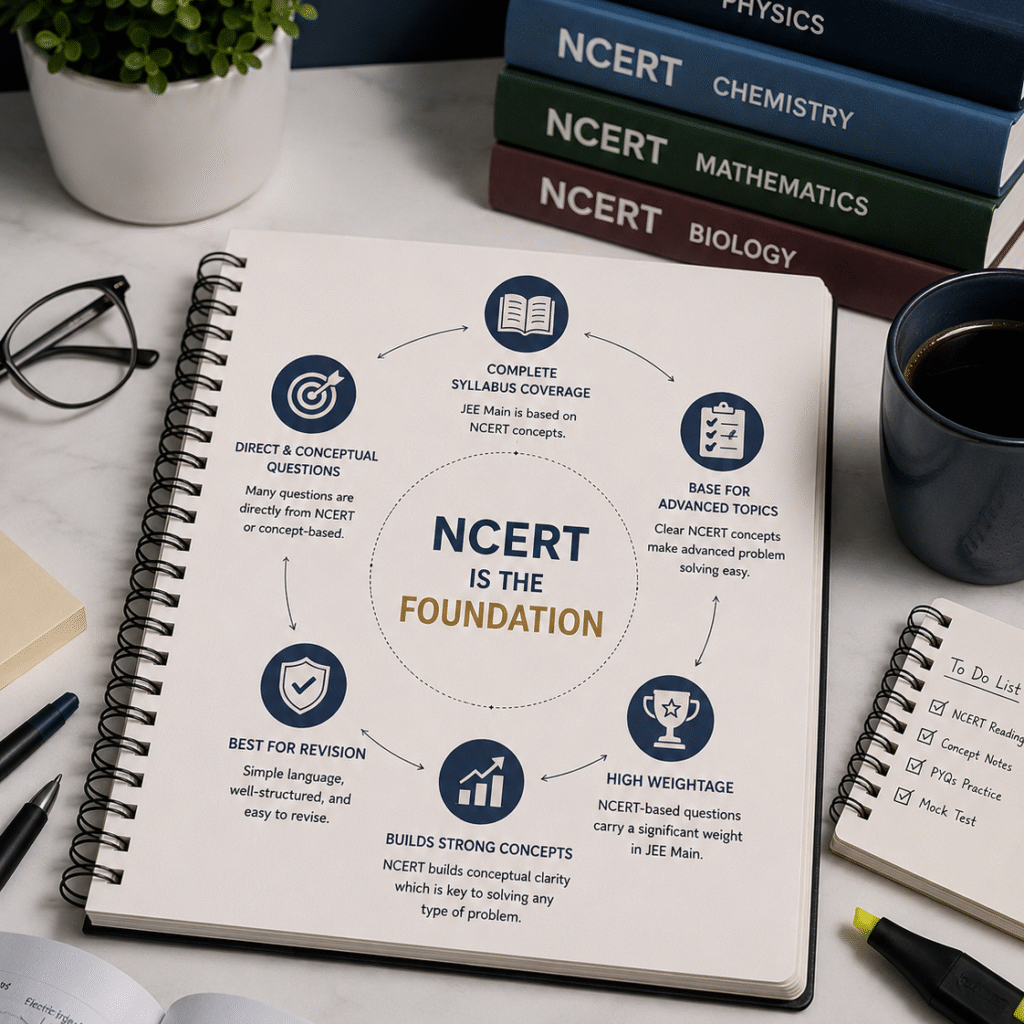
The syllabus of JEE Main is based entirely on the Class 11 and Class 12 curriculum, and NCERT textbooks are the official foundation of these topics.
Studying NCERT helps students:
- Build strong conceptual understanding.
- Learn standard definitions and formulas.
- Understand the fundamentals of every chapter.
- Prepare for board examinations simultaneously.
Students should never skip NCERT while preparing for JEE Main.
Is NCERT Enough for Physics?
The answer is No—not by itself.
NCERT Physics explains concepts well, but JEE Main questions often require students to apply multiple concepts together and solve numerical problems quickly.
Students should:
- Read every NCERT chapter carefully.
- Understand derivations and concepts.
- Solve all NCERT examples and exercises.
- Practice additional numerical questions.
- Solve previous years’ JEE Main papers.
Success in Physics depends more on conceptual understanding and problem-solving than on memorizing formulas.
Is NCERT Enough for Chemistry?
Chemistry is the subject where NCERT plays the biggest role.
However, the answer depends on the branch of Chemistry.
Physical Chemistry
NCERT builds the concepts well.
Students should additionally:
- Practice numerical problems.
- Solve objective questions.
- Improve calculation speed.
Organic Chemistry
NCERT explains many important reactions and concepts, but students should also:
- Understand reaction mechanisms.
- Practice conversion-based questions.
- Solve application-oriented problems.
Simply memorizing reactions is not sufficient.
Inorganic Chemistry
For Inorganic Chemistry, NCERT is extremely important.
Many questions in JEE Main are directly or indirectly based on NCERT.
Students should:
- Read every line carefully.
- Learn trends and exceptions.
- Revise regularly.
- Highlight important facts.
For Inorganic Chemistry, NCERT should be your primary resource.
Is NCERT Enough for Mathematics?

No.
NCERT introduces concepts and formulas, but JEE Main Mathematics is much more
application-oriented.
Students should:
- Master every NCERT concept.
- Solve additional objective questions.
- Practice higher-level problems.
- Improve speed and accuracy through regular practice.
Mathematics requires continuous problem-solving rather than repeated reading.
Why Students Should Not Ignore NCERT
Some students make the mistake of immediately starting advanced books without completing NCERT.
This creates weak fundamentals.
Without strong basics:
- Advanced concepts become confusing.
- Difficult questions become harder to solve.
- Students lose confidence.
Every advanced topic is built upon basic concepts introduced in NCERT.
What Should Students Do After Completing NCERT?
Once NCERT is completed thoroughly, students should move to question practice.
This includes:
- Chapter-wise MCQs
- Previous years’ JEE Main questions
- Mock tests
- Mixed-topic practice papers
These resources help students learn how concepts are tested in the actual examination.
Previous Years’ Papers are Essential
After completing NCERT, students should solve previous years’ JEE Main papers.
These papers help students:
- Understand the exam pattern.
- Identify important topics.
- Improve time management.
- Build confidence.
Many concepts are repeated in different forms across multiple years.
Mock Tests Complete the Preparation
Reading books alone cannot prepare students for JEE Main.
Regular mock tests help students:
- Improve speed.
- Increase accuracy.
- Learn time management.
- Reduce examination stress.
After every mock test, students should analyze their mistakes carefully.
Common Mistakes Students Make
Many aspirants either depend completely on NCERT or ignore it altogether.Both approaches are incorrect.
Some common mistakes include:
- Skipping NCERT completely
- Memorizing instead of understanding
- Solving only theory without questions
- Ignoring previous years’ papers
- Not revising regularly
- Avoiding mock tests
A balanced preparation strategy always gives better results.
Best Strategy for JEE Main Preparation

A practical preparation strategy is:
Step 1
Complete NCERT thoroughly.
Understand every concept instead of memorizing.
Step 2
Solve all NCERT examples and exercises.
Step 3
Practice additional MCQs and numerical questions.
Step 4
Solve previous years’ JEE Main papers chapter-wise.
Step 5
Take regular mock tests.
Step 6
Analyze mistakes and revise weak topics.
Following this sequence helps students develop both conceptual understanding and problem-solving ability.
Importance of the Right Academic Guidance
Many students struggle because they don’t know how to move from NCERT-level learning to JEE-level problem-solving.
Students searching for the best coaching for Science and Maths in Dehradun should choose institutes that provide:
- Concept-based teaching
- Small batch sizes
- Personalized mentoring
- Regular doubt-solving sessions
- Chapter-wise tests
- JEE-level question practice
- Detailed performance analysis
Institutes like Igniters for Tomorrow help students build strong fundamentals through NCERT while gradually introducing higher-level JEE concepts and problem-solving techniques. This structured approach enables students to perform well in both board examinations and JEE Main.
Conclusion
NCERT is the backbone of JEE Main preparation, but it is not the entire preparation. Students who master NCERT develop strong conceptual foundations, which are essential for solving JEE Main questions. However, success in the exam also depends on applying those concepts through extensive question practice, previous years’ papers, and regular mock tests.
The best strategy is to treat NCERT as your starting point—not your finishing point. Learn every concept thoroughly, solve all exercises, practice challenging problems, and revise consistently.
With disciplined preparation, smart practice, and the right academic guidance, NCERT can become the strongest foundation for achieving an excellent score in JEE Main and moving one step closer to your dream engineering college.
Leave a Reply