



Preparing for the National Eligibility cum Entrance Test while also aiming for excellent marks in Class 12 board examinations is one of the biggest challenges for science students. Many students worry that focusing on NEET will affect their board results, while others spend all their time preparing for boards and neglect NEET.
The good news is that you do not have to choose between the two. Since the syllabus for NEET and Class 12 board examinations overlaps significantly, students can prepare for both simultaneously with the right strategy.
In this blog, we’ll discuss practical tips to balance board exams and NEET preparation without unnecessary stress.
Can You Prepare for Boards and NEET Together?

Yes, absolutely.
Every year, thousands of students score above 90% in board examinations while also securing excellent NEET ranks.
This is possible because:
- Both exams are based on the Class 11 and 12 syllabus.
- Strong conceptual understanding benefits both exams.
- Smart planning helps students avoid duplicate efforts.
Instead of preparing separately for boards and NEET, students should integrate their preparation.
Understand the Difference Between Boards and NEET
Although both exams cover similar topics, their examination patterns are different.
Board Examinations Focus On:
- Descriptive answers
- Step-wise explanations
- Diagrams and practical knowledge
- Writing skills
- Subjective presentation
NEET Focuses On:
- Multiple-choice questions (MCQs)
- Conceptual understanding
- Speed and accuracy
- Application of concepts
- Time management
Students should prepare for both question formats throughout the year.
Build Strong Concepts First
The biggest advantage in balancing boards and NEET comes from having clear concepts.
When students understand:
- Biological processes
- Chemical reactions
- Physical laws
- Numerical concepts
they perform better in both descriptive board questions and objective NEET questions.
Instead of memorizing facts without understanding, focus on conceptual learning.
Master NCERT Thoroughly
NCERT textbooks are the backbone of both board examinations and NEET preparation.
Students should:
- Read every chapter carefully.
- Understand all examples.
- Study diagrams and tables.
- Learn important definitions.
- Revise highlighted points regularly.
For Biology, NCERT is especially important because a large number of NEET questions are directly based on it.
Follow a Balanced Daily Study Schedule
A structured timetable helps students prepare efficiently for both examinations.
A balanced daily routine should include:
- School studies
- Coaching classes (if applicable)
- Self-study
- NEET MCQ practice
- Board answer-writing practice
- Revision
Instead of studying for very long hours occasionally, maintain consistency every day.
Practice Both MCQs and Subjective Questions
One common mistake students make is practicing only MCQs for NEET.
While MCQs are essential, board examinations require descriptive answers.
Students should practice:
For NEET:
- Chapter-wise MCQs
- Assertion-reason questions
- Previous years’ NEET questions
- Full-length mock tests
For Boards:
- Long-answer questions
- Short-answer questions
- Diagrams and labeling
- Sample papers
- Previous years’ board papers
Practicing both formats ensures complete preparation.
Give Equal Importance to Class 11 and Class 12
Many students ignore Class 11 while focusing only on Class 12.
This is a major mistake because:
- Nearly half of the NEET syllabus comes from Class 11.
- Many Class 12 concepts build upon Class 11 fundamentals.
Students should revise Class 11 topics regularly while studying Class 12.
Make Self-Study a Daily Habit

Classroom teaching introduces concepts, but self-study develops mastery.
Daily self-study should include:
- Revising classroom notes
- Reading NCERT
- Solving MCQs
- Practicing board questions
- Reviewing weak topics
Consistent self-study strengthens long-term retention.
Revise Regularly
Many students keep studying new chapters without revising old ones.
A simple revision strategy is:
Daily Revision
Revise the topics studied on the same day.
Weekly Revision
Review all chapters completed during the week.Monthly Revision
Revise previously completed topics and attempt a full-length mock test.
Regular revision helps students remember concepts for both board exams and NEET.
Solve Previous Years’ Papers
Previous years’ papers help students understand the actual examination pattern.
Students should solve:
- Previous years’ NEET question papers
- Board examination papers
- Sample papers
- Chapter-wise question banks
These papers improve confidence and familiarize students with commonly asked questions.
Take Regular Mock Tests
Mock tests are one of the best ways to prepare for both exams.
Students should attempt:
- Chapter tests
- Unit tests
- Full syllabus board mock tests
- Full syllabus NEET mock tests
Mock tests help improve:
- Time management
- Accuracy
- Confidence
- Exam temperament
Analyze Every Test Carefully
Many students simply check their scores after a test.
Instead, they should analyze:
- Incorrect answers
- Conceptual mistakes
- Guesswork that worked or failed
- Time management issues
- Weak chapters
- Presentation mistakes in board papers
Test analysis helps students improve much faster than writing more tests without review.
Don’t Ignore English and Practical Subjects
Many Science students spend all their time preparing for PCB subjects and forget English and practical examinations.
This often reduces their overall board percentage.
Students should allocate time for:
- English preparation
- Practical files
- Internal assessments
- Viva preparation
- Project work
Scoring well in these areas significantly improves overall board results.
Stay Healthy During Preparation
Preparing for both boards and NEET can become stressful if students neglect their health.
Maintain a healthy routine by:
- Sleeping 7–8 hours daily
- Eating nutritious food
- Drinking enough water
- Taking short study breaks
- Exercising lightly
A healthy body supports better concentration, memory, and productivity.
Avoid Common Mistakes
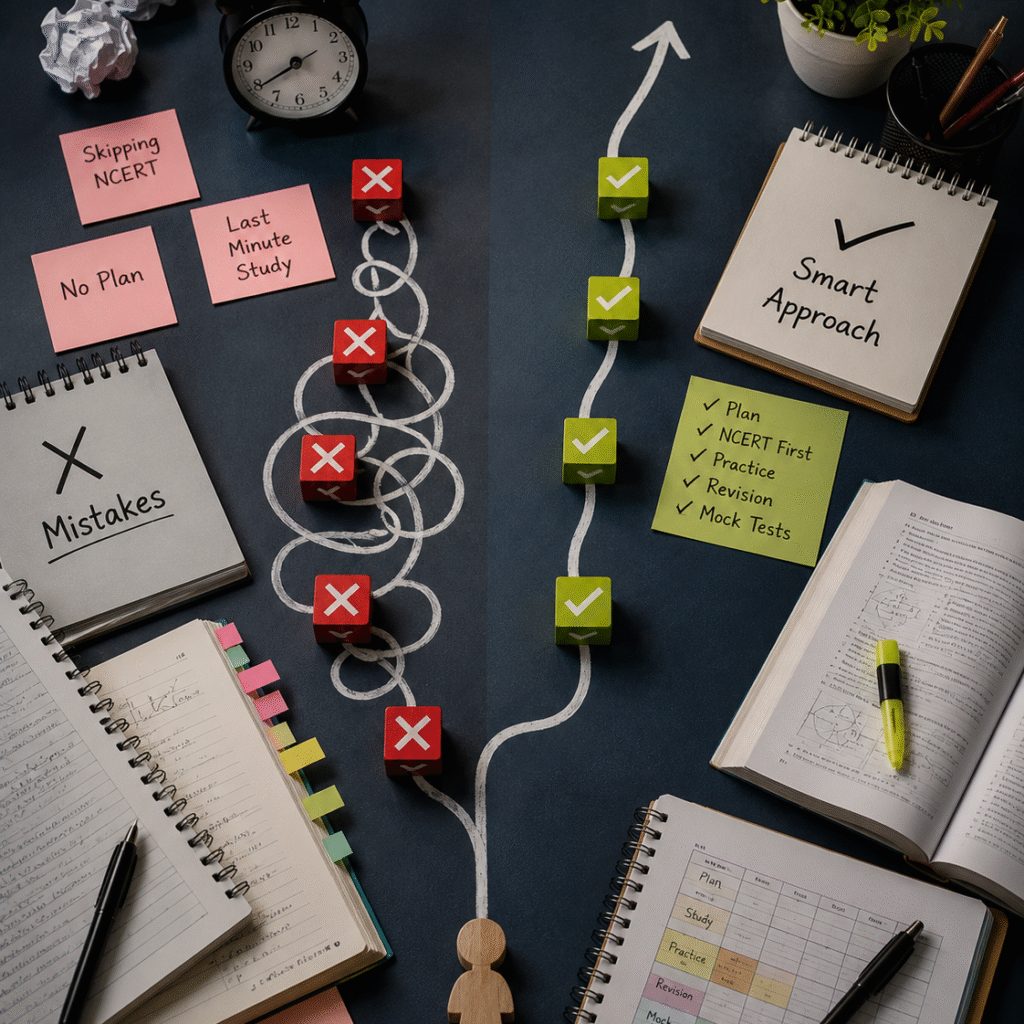
Students should avoid:
- Ignoring NCERT
- Memorizing without understanding
- Skipping revision
- Practicing only MCQs
- Ignoring board answer writing
- Comparing themselves with friends
- Studying from too many books
- Neglecting Class 11 topics
Avoiding these mistakes makes preparation much more effective.
Importance of the Right Academic Guidance
Balancing board exams and NEET becomes much easier with structured guidance and regular mentoring.
Students searching for the best coaching for Science and Maths in Dehradun should choose institutes that provide:
- Concept-based teaching
- Small batch sizes
- Personalized mentoring
- Regular doubt-solving sessions
- Separate tests for board examinations and NEET
- Continuous performance analysis
Institutes like Igniters for Tomorrow help students prepare systematically for both board examinations and NEET. Through concept-based teaching, structured study plans, personalized attention, and regular assessments, students develop the confidence and skills required to excel in both examinations without compromising either.
Conclusion
Preparing for board examinations and NEET together may seem difficult, but with the right approach, they complement each other rather than compete. Since both exams are built on the same Class 11 and 12 syllabus, strengthening your concepts, mastering NCERT, and following a disciplined study routine will benefit both.
Focus on understanding rather than memorizing, practice both MCQs and descriptive answers, revise consistently, and analyze every mock test carefully. At the same time, take care of your physical and mental health to stay productive throughout your preparation.
With smart planning, consistent effort, and the right academic guidance, you can achieve an excellent board percentage while also securing a strong NEET rank. Remember, success comes from studying strategically—not from choosing one goal over the other. Stay focused, trust the process, and keep moving toward your dream of becoming a doctor.


Leave a Reply