



For students in Classes 11 and 12, one of the biggest concerns is managing board exam preparation alongside the Joint Entrance Examination – Main and Joint Entrance Examination – Advanced. Many students believe they need to choose between scoring well in boards or cracking JEE, but that’s not true.
The reality is that both board exams and JEE are based on the same Class 11 and 12 syllabus. The difference lies in the type of questions asked and the approach required to solve them.
With the right planning, consistent study habits, and proper guidance, students can perform well in both board examinations and JEE without feeling overwhelmed.
In this blog, we’ll discuss practical strategies to balance board exams and JEE preparation effectively.
Is It Possible to Prepare for Boards and JEE Together?

Yes, absolutely.
Thousands of students every year score above 90% in board exams while also securing excellent JEE ranks.
The reason is simple:
- Both exams cover almost the same syllabus.
- Strong concepts help in both board and competitive exams.
- Smart planning reduces unnecessary workload.
Instead of treating them as two separate goals, students should prepare for them together.
Understand the Difference Between Boards and JEE
Although the syllabus is similar, the examination pattern is different.Board Exams Focus On:
- Descriptive answers
- Step-wise presentation
- Theory and derivations
- Practical knowledge
- Writing skills
JEE Focuses On:
- Conceptual understanding
- Numerical problem-solving
- Application of concepts
- Logical thinking
- Speed and accuracy
Students should prepare according to both formats instead of studying separately for each exam.
Build Strong Concepts First
The biggest advantage during board preparation comes from having strong conceptual understanding.
If students understand:
- Why formulas work
- How concepts are connected
- Where formulas are applied
Then both subjective board questions and objective JEE questions become much easier.
Instead of memorizing, focus on learning concepts thoroughly.
Complete NCERT Thoroughly
NCERT textbooks should be the foundation of your preparation.
Students should:
- Read every chapter carefully.
- Solve all examples.
- Complete exercise questions.
- Learn definitions and derivations.
- Revise diagrams and important notes.
NCERT is extremely important for board examinations and also forms the conceptual base for JEE, especially in Chemistry.
Follow a Balanced Daily Schedule
One of the biggest mistakes students make is spending all their time on either board preparation or JEE.
Instead, maintain a balanced routine.
A typical day should include:
- School studies
- Coaching classes (if applicable)
- Self-study
- JEE problem-solving
- Board answer-writing practice
- Revision
Studying consistently every day is much more effective than long, irregular study sessions.
Practice Both Objective and Subjective Questions
Since board exams and JEE have different question formats, students should practice both.
For JEE:
- Solve MCQs
- Practice numerical problems
- Attempt previous years’ questions
For Boards:
- Write descriptive answers
- Practice derivations
- Solve sample papers
- Improve presentation skills
This dual approach prepares students for both examinations simultaneously.
Give Equal Importance to Class 11 and Class 12
Many students neglect Class 11 topics while focusing only on Class 12.
This is a serious mistake because:
- Nearly half of the JEE syllabus comes from Class 11.
- Many Class 12 concepts depend on Class 11 fundamentals.
Students should regularly revise Class 11 topics even while studying in Class 12.
Make Self-Study Your Priority
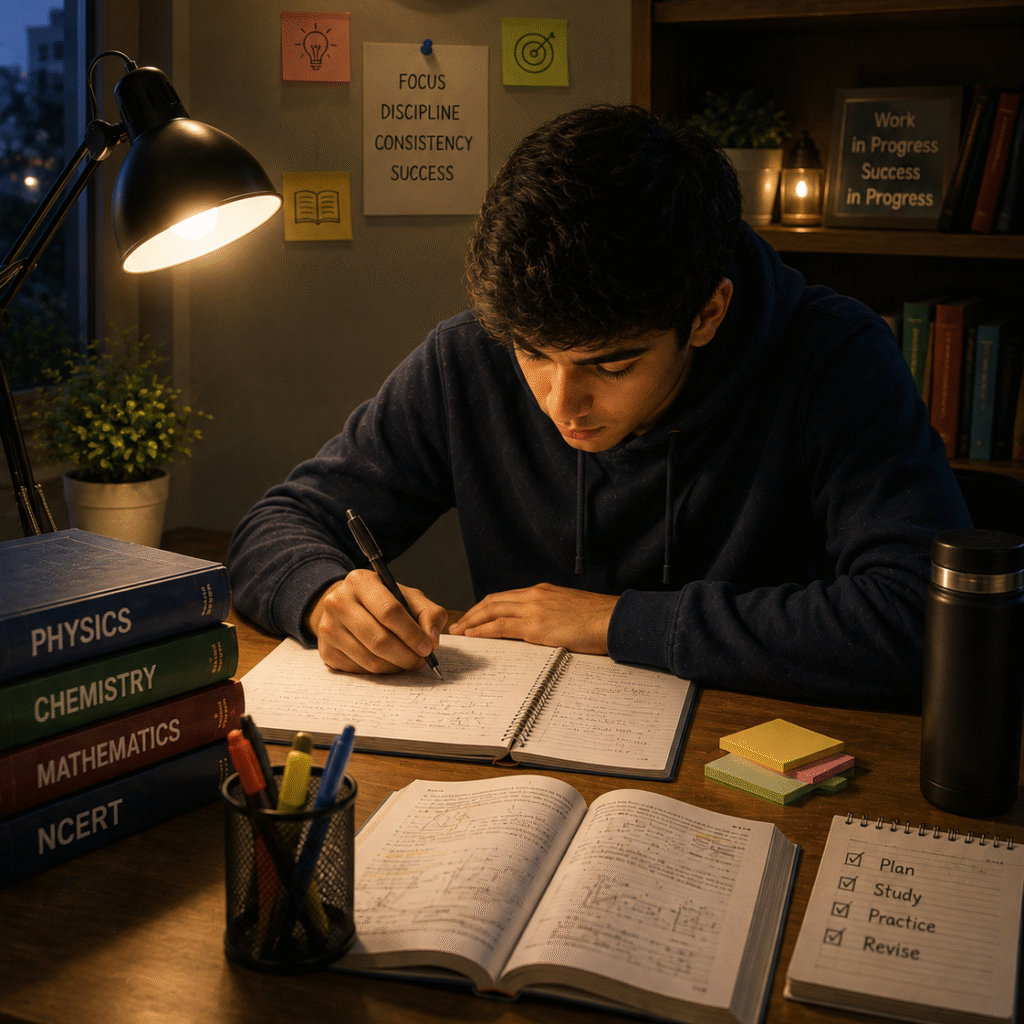
Whether you attend coaching or not, self-study is essential.
Every day, students should:
- Revise classroom notes.
- Solve additional questions.
- Strengthen weak concepts.
- Review formulas.
Self-study transforms classroom learning into long-term understanding.
Revise Regularly
Revision prevents forgetting.
A simple revision strategy is:
Daily Revision
Revise topics taught on the same day.
Weekly Revision
Review chapters completed during the week.
Monthly Revision
Revise all previously completed topics and attempt a full-length test.
Regular revision reduces stress before board exams and JEE.
Take Mock Tests for Both Exams
Mock tests help students understand their preparation level.
Students should attempt:
- Chapter-wise tests
- Board pattern sample papers
- JEE mock tests
- Full syllabus tests
Mock tests improve:
- Time management
- Confidence
- Accuracy
- Exam temperament
Analyze Every Test
Many students simply check their score after a test.
Instead, analyze:
- Incorrect answers
- Conceptual mistakes
- Calculation errors
- Presentation mistakes (for boards)
- Time management issues
Learning from mistakes is one of the fastest ways to improve performance.
Don’t Ignore English and Practical Subjects
Many Science students spend all their time on PCM subjects and ignore English and practical examinations.
This can reduce overall board percentage.
Allocate regular time for:
- English
- Practical records
- Internal assessments
- Project work
Scoring well in these areas helps improve the final board result.
Avoid Common Mistakes
Students should avoid:
- Studying only one subject for several days
- Memorizing instead of understanding
- Ignoring NCERT
- Skipping revision
- Avoiding mock tests
- Comparing themselves with friends
- Studying from too many books
A focused and balanced approach always produces better results.
Stay Healthy During Preparation
Preparing for two major examinations can be stressful.
Students should:
- Sleep 7–8 hours daily.
- Eat healthy food.
- Stay hydrated.
- Exercise lightly.
- Take short study breaks.
Good physical and mental health improves concentration and productivity.
Importance of the Right Academic Guidance

Balancing board exams and JEE becomes much easier with structured guidance and proper mentoring.
Students searching for the best coaching for Science and Maths in Dehradun should choose institutes that provide:
- Concept-based teaching
- Small batch sizes
- Personalized mentoring
- Regular doubt-solving sessions
- Separate tests for board exams and JEE
- Continuous performance analysis
Institutes like Igniters for Tomorrow help students prepare systematically for both board examinations and JEE. Through concept-based learning, structured study plans, personalized attention, and regular assessments, students develop the confidence to excel in both examinations without compromising either.
Conclusion
Preparing for board exams and JEE together may seem challenging, but it is completely achievable with the right strategy. Instead of treating them as separate goals, focus on building strong concepts that serve as the foundation for both examinations.
Study consistently, master NCERT, practice both objective and subjective questions, revise regularly, and analyze your performance after every test. Most importantly, maintain a balanced routine that includes self-study, school, coaching, revision, and adequate rest.
With disciplined preparation, smart time management, and the right academic guidance, you can confidently score well in your board examinations while also securing an excellent JEE rank. Remember, success is not about choosing between boards and JEE—it is about preparing intelligently for both.
Leave a Reply